
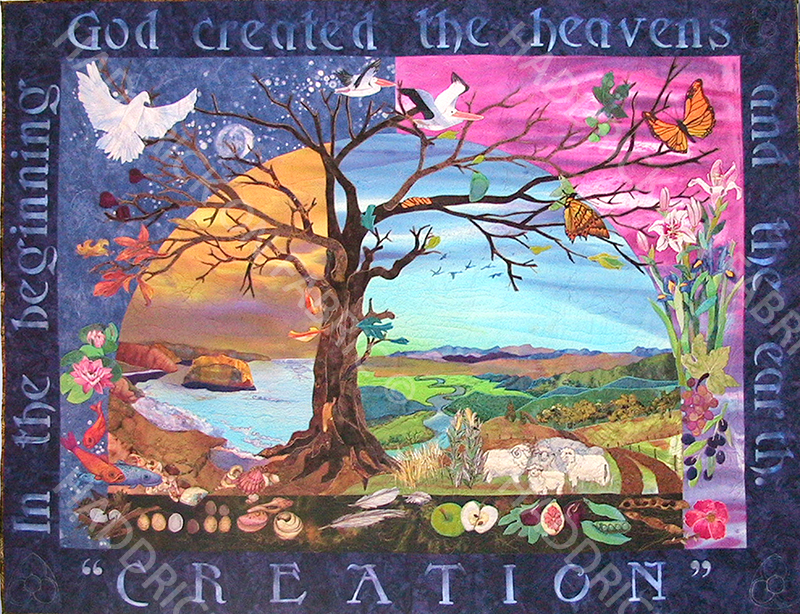
Responding to the particular requirements of a commissioned art work like ‘Creation’ can be both challenging and confronting. Working as an artist, I believe that outcomes can not be specified in advance, other than in a few words of reassurance. This ‘leap of faith’ and confidence in my creative interpretation on the Creation story theme by the Scots Church committee and Margaret Nolan in particular has been confirming and I am grateful for the confidence and artistic freedom entrusted in me. The imagery and symbolism, no matter how carefully researched and planned, took a journey of its own. I hope those who enjoy this art work take liberties in their individual interpretations and perhaps enjoy the colourful expanses and spirituality of this piece.
I hand dyed, painted, printed, discharge dyed, drew, stenciled and stitched nearly all of the fabrics for this quilt. Grappling with God’s seven days of creation, on one surface meant that I needed symbols and metaphors to help explain key ideas. I was mindful of the artists of the Middle Ages through to the Renaissance who had struggled with similar visual challenges and sought inspiration in books. Unlike in times past however, culture of the 21st century shows little interest or understanding in the iconography of religious art. So I studied Gods’ word. reading from the Bible… “In the beginning, God created the heavens and the earth”. In Genesis the descriptive account of Gods’ creation story, how chaos becomes order, cycles began, harmony and rhythm resided in a place harmonious to man, creatures and all of nature. Researching themes on the internet in the Goolwa library over the Christmas holidays gave me ideas, as later, did the numerous books and articles on this topic. Identifying the plants and animals of the Bible and understanding their significance helped to establish for me, some guidelines for particular imagery that could be used. Symbolic use of colour enabled yet another layer of meaning to evolve. In explaining the symbols used, I would invite the viewer to enjoy them without being limited by them. Genesis 1 was the starting point and my references are not fixed into that time. However, consider the ideas here as a preface to your own interpretation.
The earth was formless, empty and dark as seen in the quilts’ borders. Light; night and day are illustrated, with the sky, water, land and evening / early morning view of the beach, taken from Seal Bay on Kangaroo Island, South Australia on the left hand side. Lights in the expanse of the sky; stars and the moon shine, with the idea of seasons depicted across the tree, in the smaller branches. Referred to [Hab3:17,18] in the Bible as a tree that does not bud, nor have grapes… the Fig tree Ficus carica is the central element of this design. This common fig was the most widely planted tree in the bible lands, living, with the olive tree, in excess of 200 years. The fig is the first tree mentioned in the Bible…with Adam and Eve. There are numerous references to its plentiful fruit, leaves and stature throughout the Bible and it depicts here not only the seasons, but the fruit of its crop and as the habitat to the Butterflies’ life cycle. Seed bearing plants and trees bearing fruit, with seed according to their kind are illustrated, including Apples, Beans, Figs, Olives, Acacia, Grapevines, Lilium, Iris, Christmas Rose, Waterlily, Wheat, Barley and Corn. Night is separated from day as seen in the right hand midday landscape; a compilation of the Barossa landscape and the lower Flinders Ranges, South Australia.
The waters, teeming with living creatures and birds flying above, were created on the fifth day. Fish swim beneath the flowering Waterlily. These opening blossoms of beauty and purity, root themselves and thrive in mud. [paralleled in the life of a Christian’ to rise above the unlovely and evil]. Shells; the fruits and life of the sea; symbol of Baptism are illustrated alongside a bird nest, with three eggs. Neighboring this are different eggs, illustrating the idea of .. ‘to be fruitful and to increase in numbers and fill the earth according to their kinds’. Pelicans, symbol of the Atonement, soar high in the warm thermals of an evening sky while beneath, Ibis or storks migrate north toward the horizon. The Butterfly, is shown as a caterpillar, the pupa, through to the adult butterfly, serving as a reminder of seasons, life cycles and as the symbol of the resurrection and eternal life. Uppermost is the Dove, emblem of innocence and purity, signified as the Holy Spirit and the presence of God hovering over the water at creation. River nourishes the landscape and provides sustenance for the crops that appear in the foreground.
God created man in his own image; as male and female he created them. Absent, yet evident in this landscape, human presence can be seen in the tilled crops, the roughly hewn road and the fences that hold sheep and protect the furrowed hills in readiness for cropping. You may discover a shard of china, that hints at mans’ refinement of nature and his creative accomplishments or perhaps find the lone eagle, the migratory ducks, ‘grapes’ of sea weed, a dragonfly, a moth or a locust hidden amongst the stitched feathers. The circular ‘Trinity’ window that sits high above the altar in Scots Church can be found stitched into the corners of this quilt, acknowledging the congregation for whom this quilt was designed, as well as visually linking and stabilizing in between the first words of the Bible; Genesis 1…
“In the beginning, God created the heavens and the earth”.
The Creation Quilt can be viewed at Scots Church, North Tce Adelaide.